CLAYEXP
CLAY EXPOSURE, Modeling the risk of exposure to swelling-shrinkage of clays
Overview
Clay shrinkage-swelling: an underestimated climate risk
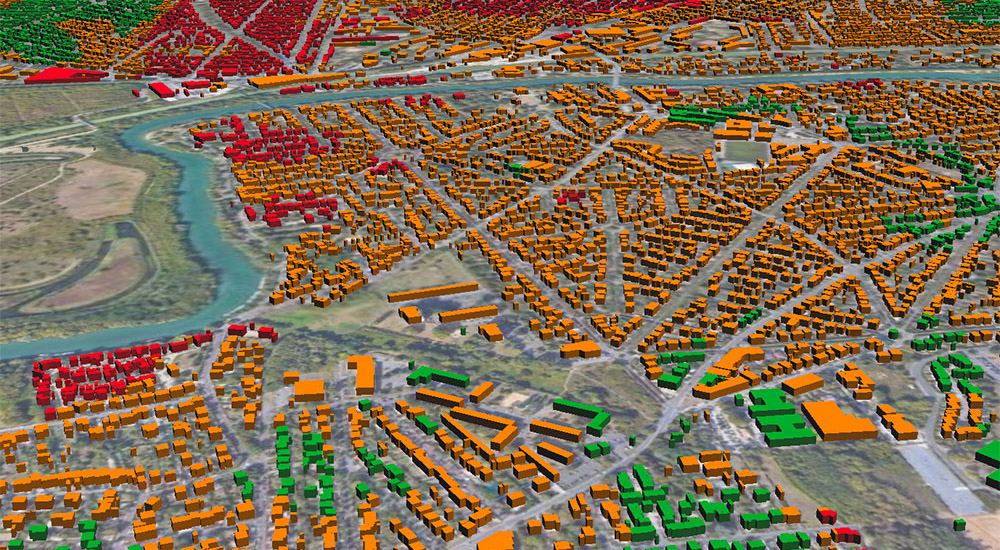
Clay swelling and shrinkage (CSS) is one of the most costly geological hazards in France. Indeed, with the intensification of droughts linked to climate change, differential ground movements are causing increasing structural damage to buildings, infrastructure and agricultural land. In France, 48% of soils are moderately to highly exposed to CSS, putting more than 10 million detached houses at risk, with an annual insurance cost exceeding €1.5 billion.
However, current mapping tools remain static and imprecise: they rely on low-resolution lithological maps that fail to capture the dynamic nature of the phenomenon, which is heavily influenced by weather conditions and vegetation.
An innovative approach guided by AI and Earth observation
CLAYEXP (Clay Exposure) offers a methodological breakthrough by combining Copernicus satellite data (Sentinel-1 and Sentinel-2), in-situ measurements and artificial intelligence models to produce dynamic RGA exposure indices at municipal and sub-municipal levels (IRIS).
The core of the project is based on an AI model trained using natural disaster declarations and historical claims data, cross-referenced with time series of soil moisture, ground deformation measured by radar interferometry (InSAR), drought indices and geological data. This combination produces two complementary indicators — a dynamic hazard index (RGA-DLHI) and an exposure index (RGA-DLEI) — the details of which are presented in the Results section below.
A regional demonstrator in Occitanie
The project will be rolled out primarily in the Occitanie region, one of the areas most exposed to CSS in mainland France. Eight sites equipped with multi-parameter sensors (meteorology, soil moisture, GNSS) will enable the model’s results to be calibrated and validated. The methodology, built on a modular basis, is designed to be transferable to other regions in France and internationally.
A consortium combining innovation and scientific infrastructure
CLAYEXP brings together two complementary partners:
- Deltaforms is an innovative company specializing in AI-driven SaaS (Software as a Service) solutions for geohazards. It is responsible for project management, indicator design, data processing and interoperability with users’ GIS systems, drawing on dual expertise in geosciences and actuarial methodology.
- CNRS / Data Terra is the French research infrastructure dedicated to Earth system observation. It contributes its expertise in geospatial data processing, generates the input satellite products, deploys in-situ measurement sites and ensures the dissemination of results on THEIA platforms.
This partnership, combining operational engineering, innovative Earth observation processing and national digital infrastructure, guarantees the reliability and sustainability of the project’s deliverables.
Application site(s)
Occitanie, France
Data
Satellite
Sentinel-1 (SAR radar):
Millimetre-scale ground deformation maps / time series derived using InSAR SBAS/PS-DS processing
Estimation of relative soil water content using the Data Terra/THEIA data hub and S²MP processing service.
Sentinel-2 (optical and multispectral): surface reflectance, NDVI, SWI / Wetness Index, OSO / land cover dynamics from the Data Terra/THEIA data hub
EGMS (European Ground Motion Service) products with time series of deformation and velocity maps
CLMS (Copernicus Land Monitoring Service) products: imperviousness, regional soil moisture index
Other
Météo-France: hydro-meteorological observations and simulations (rainfall, evapotranspiration)
Disaster-related decrees from public bodies and anonymized, aggregated insurance claims (where available and officially provided under an NDA)
Topographic maps (IGN/LiDAR-VHR)
Lithological/pedological maps (BRGM)
Data from multi-parameter instruments (meteorology, soil moisture, deformation from GNSS/in-situ extensometers) installed at eight critical sites
Results – Final roduct(s)
👉 CLAYEXP will provide a methodology based on Earth observation and derived from AI, capable of estimating the spatial probability of RGA risk occurrence. The indices will be delivered at two scales - municipal and IRIS - with several categories and levels of uncertainty:
- RGA-DLHI (Dynamic Layers Hazard Index): a hazard index based on changes in ground deformation and dynamic environmental parameters.
- RGA-DLEI (Dynamic Layers Exposure Index): an exposure index that incorporates the distribution of assets and population, designed to provide public authorities with key risk indicators.
👉 The products will be accessible via the Data Terra / THEIA portals in accordance with FAIR principles, with data feeds (WMS) directly feeding into users’ GIS systems. Upon completion of the project, CLAYEXP will deliver:
- The RGA-DLHI and RGA-DLEI indicators at the municipal and IRIS levels
- Web maps and APIs displaying aggregated values for consultation and integration
- A methodological note and a reproducible example
- GIS-compatible exports, documented APIs and aggregated metadata
The demonstrator does not include results at the plot or building level, nor does it provide insurance ratings. These services are developed separately by Deltaforms as part of its commercial offering.
Related project(s)
SCO projects:
- BOSCO, satellite-based soil moisture monitoring
- EO4DroughtMonitoring, satellite-based drought monitoring and forecasting
- FLAude, indicators for the prevention and reduction of risks associated with intense runoff
- COSIADES, automatic generation of detailed land cover maps from very high-resolution (VHR) satellite imagery