SIRIOS
Satellite radar interferometry monitoring of long linear infrastructures
Overview
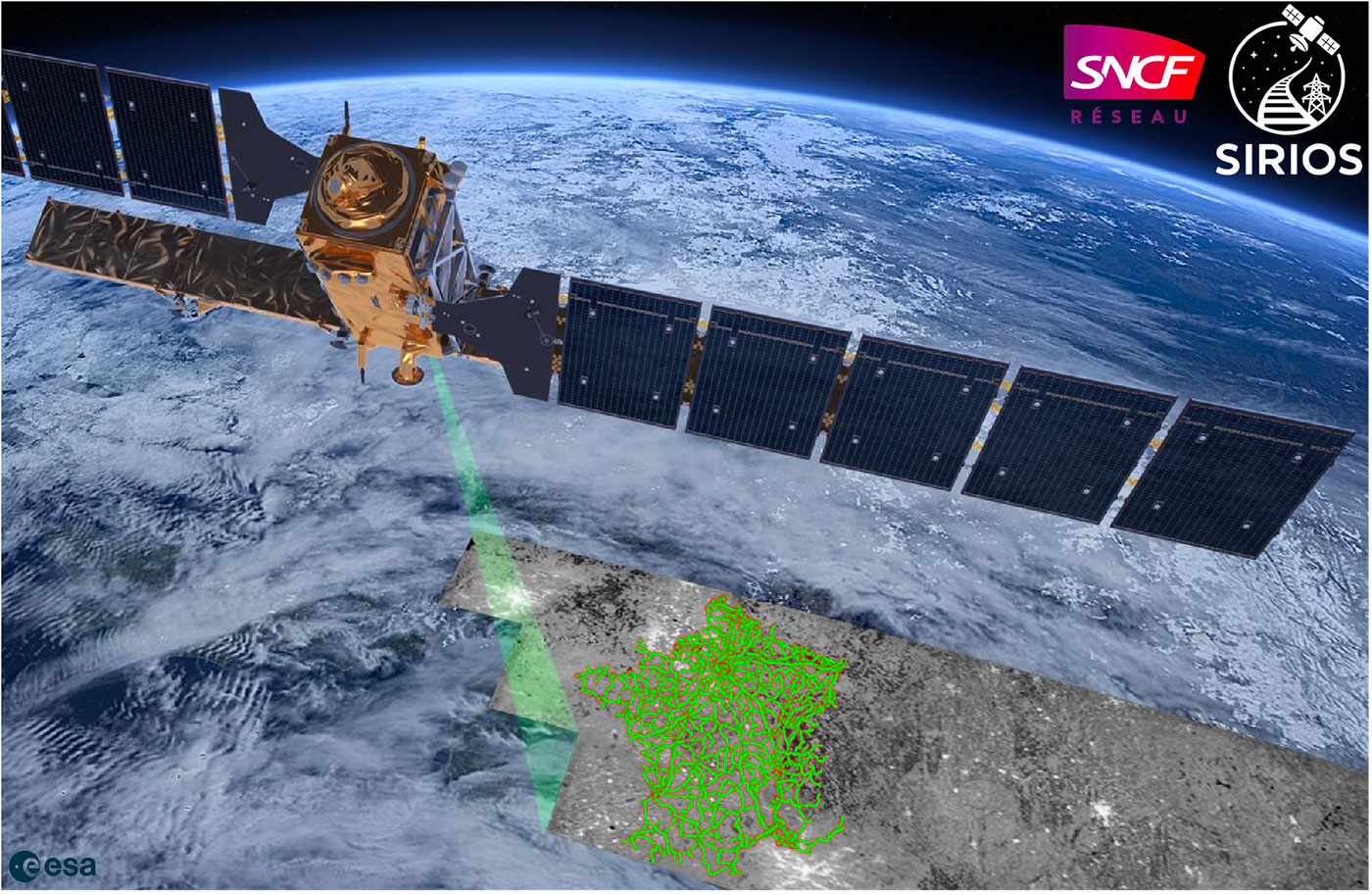
The SIRIOS project aims to improve the monitoring and maintenance of long linear infrastructures (e.g. railways, energy networks) by exploiting the capabilities of satellite radar interferometry (InSAR). This technology accurately measures variations in distance between a satellite and the Earth's surface through repeated acquisitions, providing comprehensive and detailed mapping of ground deformations. By integrating InSAR technology into infrastructure management strategies, the tool developed will make it possible to anticipate damage and optimize maintenance interventions by planning them in the right place and at the right time.
Long linear infrastructures, such as the French National Rail Network (RFN) managed by SNCF Réseau, extend over thousands of kilometers and are subject to climatic hazards and structural ageing. Currently, their monitoring relies mainly on periodic surveillance rounds, visual inspections and in situ measurements, which do not allow for comprehensive and frequent coverage of the networks. Thanks to the macro-scale monitoring potential of satellite technology, SIRIOS addresses these challenges by introducing a condition-based maintenance approach, where interventions are planned and prioritized according to deformation trends detected by InSAR across the entire network. By improving infrastructure monitoring, the solution developed will help to enhance the safety and resilience of transport and energy infrastructure networks.
Application site(s)
Project covering the entire French metropolitan area.
Data
Satellite
- Sentinel-1
Other
- Levelling, GNSS, EGMS, inclinometer, LiDAR
Results – Final product(s)
At the end of the project, a map of risk areas will be produced at regional level. An alert system will be tested and refined according to the different types of infrastructure. A demonstration and usage phase will enable SNCF Réseau to tailor the features to its needs.
References
- Berardino, P., Fornaro, G., Lanari, R., & Sansosti, E. (2002). A new algorithm for surface deformation monitoring based on small baseline differential SAR interferograms. IEEE Transactions on geoscience and remote sensing, 40(11), 2375-2383.
- Doin, M. P., Lodge, F., Guillaso, S., Jolivet, R., Lasserre, C., Ducret, G., ... & Pinel, V. (2011, September). Presentation of the small baselin nsbas processing chain on a case example: The etan deformation monitoring from 2003 to 2010 using envisat data. In Fringe Symposium.
- Ferretti, A., Prati, C., & Rocca, F. (2000). Nonlinear subsidence rate estimation using permanent scatterers in differential SAR interferometry. IEEE Transactions on geoscience and remote sensing, 38(5), 2202-2212.
- Ferretti, A., Fumagalli, A., Novali, F., Prati, C., Rocca, F., & Rucci, A. (2011). A new algorithm for processing interferometric data-stacks: SqueeSAR. IEEE transactions on geoscience and remote sensing, 49(9), 3460-3470
- Martin, G., Hooper, A., Wright, T. J., & Selvakumaran, S. (2022). Blind source separation for MT-InSAR analysis with structural health monitoring applications. IEEE Journal of Selected Topics in Applied Earth Observations and Remote Sensing, 15, 7605-7618.
- Massonnet, D.; Rossi, M.; Carmona, C.; Adragna, F.; Peltzer, G.; Feigl, K.; Rabaute, T. The displacement field of the Landers earthquake mapped by radar interferometry. Nature 1993, 364, 138–142