


SCOInternational
Next ClimateSCOpe
May/June 2026 on climate challenges in Africa


ClimateSCOpe 3: From space to health
|
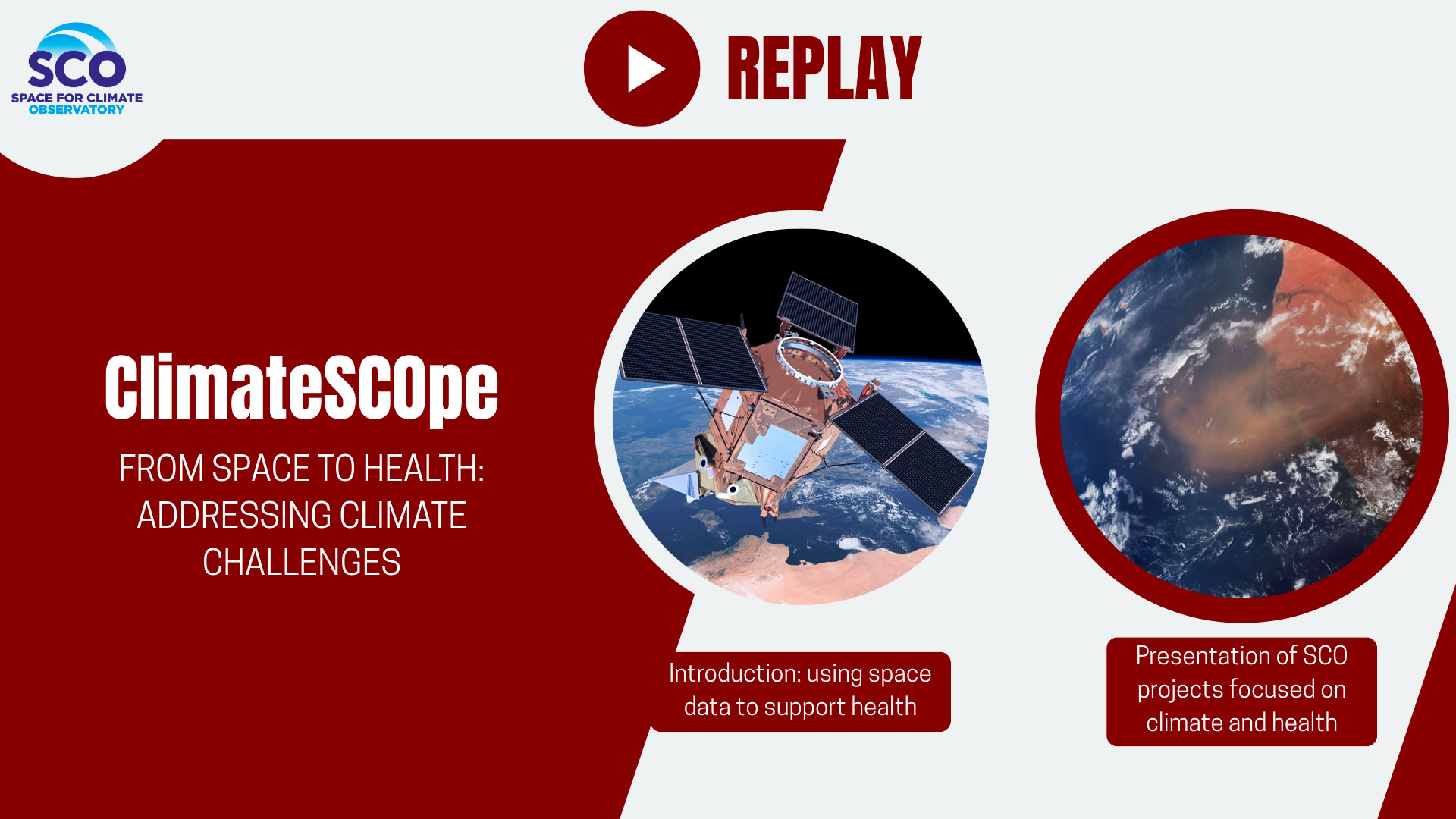
From monitoring air pollution to tracking environmental factors that contribute to certain diseases, spatial data has proven to be incredibly effective. This was demonstrated through several projects during the 3rd ClimateSCOpe, an international webinar dedicated to SCO projects on every continent. |
To receive invitations to the ClimateSCOpes in your inbox and automatically save them in your calendar, sign up HERE! |
Interventions:
-
🛰️🏥 Preamble: presentation of Earth Observation Health Architecture (EO-HEART) and the ESA initiative, EO4Health by Caroline Perrin Franck from the Geneva Digital Health Hub.
-
🇨🇳 EWSHR project, by Shenxin Li from Central South University (Chine), which has developed two online services for monitoring and early warning of health risks linked to air pollution: a WebGIS platform on air quality and health risks, and an app providing real-time assessment of pollutant concentrations and health risks from exposure.
-
🇫🇷 Arbocarto project, by Annelise Tran from CIRAD (France), whose application generates predictive maps of the abundance of mosquitoes, vectors of human arboviruses, in order to target at-risk neighborhoods and guide vector control actions. Automated in its phase 2 with the support of the SCO and continuously improved thanks to the support of the French Ministry of Health, the tool is increasingly being used.
▲▼ The use of satellite data to characterize the links between environmental factors and diseases is increasingly recognized. Read: When SCO health projects become references, news item dated November 27, 2023
- 🇫🇷 ClimHealth project, by Vincent Herbreteau form IRD (France), which has developed two online early warning system demonstrators to provide information on environments conducive to disease transmission: LeptoYangon, a local tool to prevent leptospirosis in Myanmar, and ClimHealth, a generic tool that can address all diseases and symptoms influenced by the environment. Adaptable to any location, the application is open source.