


SCOFrance
PartnersGET/IRD, Adour Garonne, Hetwa, Magellium, CNES
Useful linksProject page
KeywordsWater, monitoring, quality, small reservoirs


XtremQuality: monitoring the 90% of freshwater that nobody looks at
The focus on small bodies of water: a new way of thinking about water
As floods and droughts intensify due to climate change, XtremQuality was born out of a conviction: whilst scientific literature on small water bodies of 1 to 10 ha is virtually non-existent, it is possible to monitor them using Sentinel-2 satellite data. This conviction, now confirmed, is held by Jean-Michel Martinez, a hydrology researcher at IRD and project lead for XtremQuality: “Water quality provides insights into global and regional changes, whether regarding the evolution of the hydrological cycle, land use, erosion, fertilizers, and so on. However, in France as elsewhere, when we talk about the water situation, we focus on large reservoirs but overlook 90% of the water in catchment areas, stored in tens of thousands of small reservoirs. Yet it is precisely these small lakes that farmers and towns rely on when droughts strike. In fact, whether there is a surplus or a shortage of water, there is a gaping hole in observations—and therefore in information—for public authorities.”
Having worked for over fifteen years on monitoring inland waters via satellite, Jean-Michel Martinez has thus “broken two paradigms [:] with XtremQuality, we demonstrate the satellite’s capability at 20-metre resolution to monitor small reservoirs with the same rigor as large lakes. In addition, we are demonstrating the effectiveness of AI in overcoming satellite limitations, such as cloud cover, and providing a finalized, continuous product, both in time and space.”
From raw data to a comprehensible indicator
By combining remote sensing and AI, XtremQuality presents its results in the form of three simple water quality indicators: chlorophyll-a, turbidity and the trophic index*.
* Eutrophication indicates an excessive influx of nutrients (nitrates and phosphates) into an aquatic environment, which can lead to the proliferation of aquatic plants -some of which are toxic- and a reduction in water oxygenation.
The XtremQuality platform, developed using Sentinel-2 time series data from 2018 to 2023 covering South-western France, is freely accessible with two viewing scales.
|
👉 The user (you, in just a few clicks ;-), is greeted by a map of south-western France. Select the desired indicator and time step, for example ‘interannual chlorophyll-a’, then click on ‘load data’. Over 2,000 colored points appear simultaneously, each representing a lake: the greener the color, the better the water quality. |
|
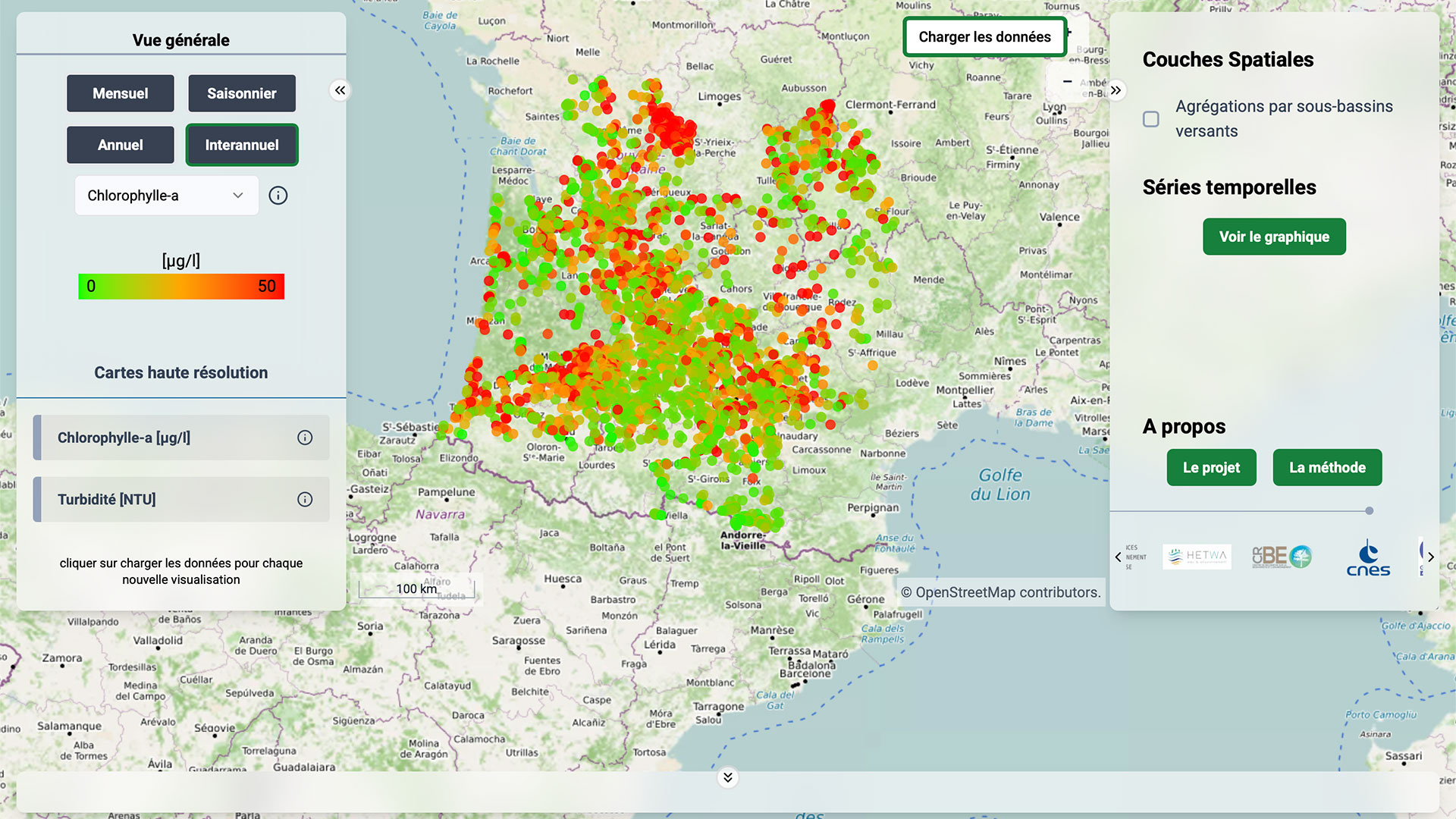
👉 You can zoom in, click on an urban gravel pit, explore the interannual trend in its turbidity, and thus detect a break in the trend. A red point? Perhaps the recent installation of a water sports center. “It’s not necessarily ‘bad’; it indicates a change in water quality. And it’s this visual representation that speaks most clearly to the user,” explains Jean-Michel Martinez.
👉 The user can select a water body, view (and download) time series of measurements for each indicator in graph form.
|
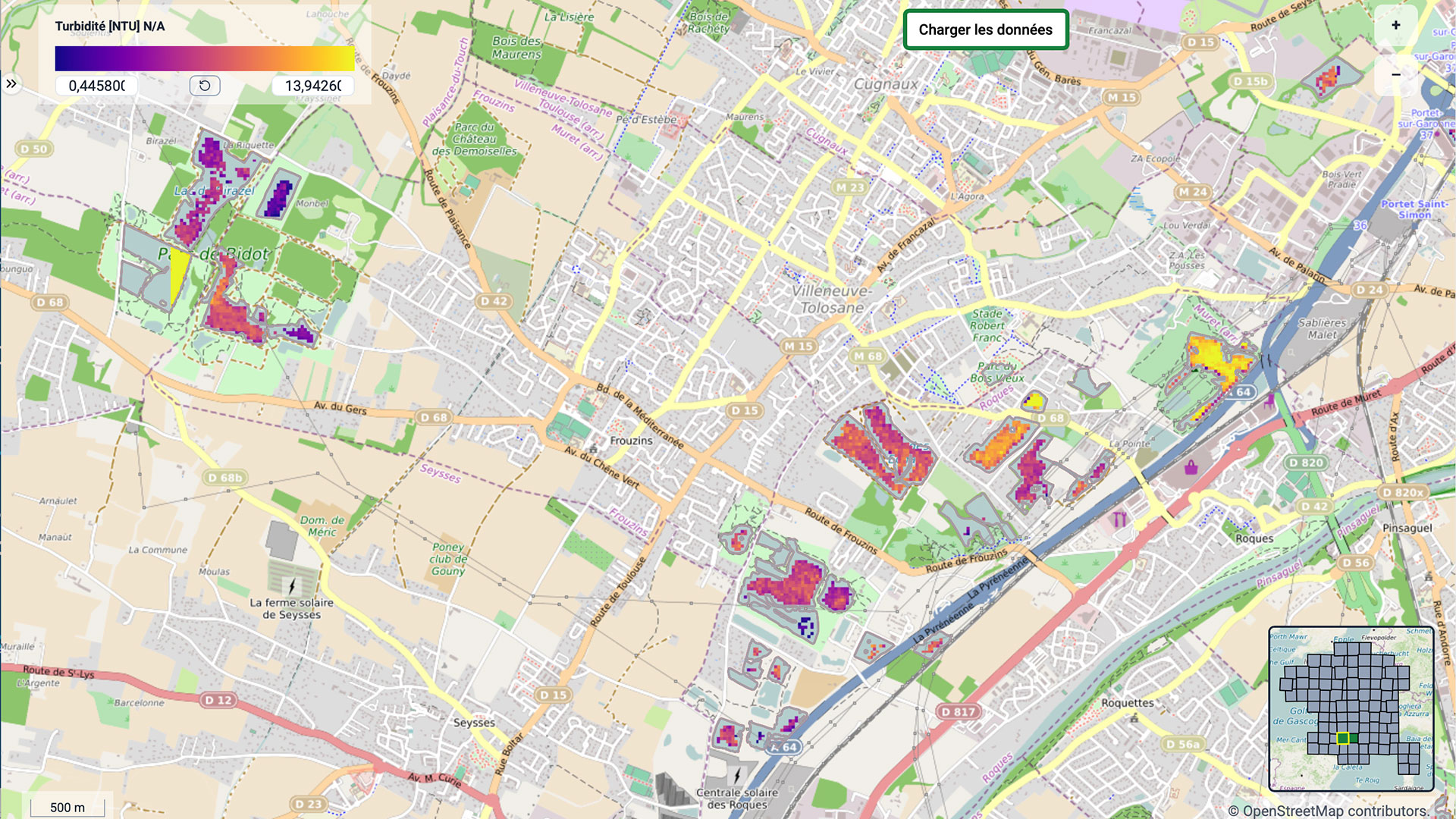
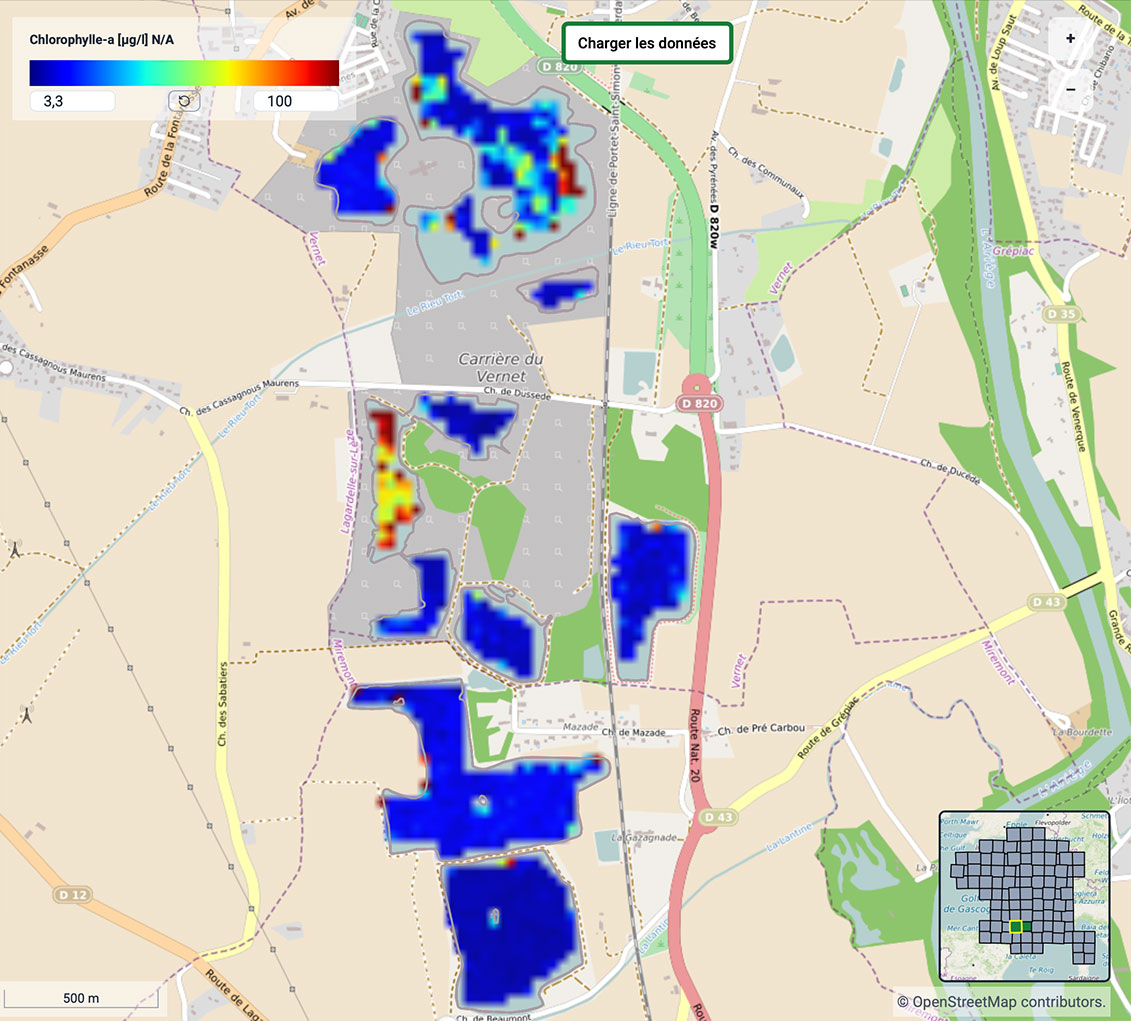
👉 For experts, the high-resolution mode allows the satellite map to be viewed at 20-metre resolution, on the exact date the satellite passed over.
► High-resolution satellite map of the Chlorophyll-a index for quarry lakes. © IRD |
|
As the expert puts it, “XtremQuality is not a real-time alert system – at least not yet! – but rather a knowledge tool, based on the flow paths of water bodies, an approach consistent with the European Water Framework Directive”.
🖱️ Try the XtremQuality demonstrator
A validated and transferable method
|
Validations carried out on a wide variety of lakes using field data from the Adour-Garonne Water Agency confirm the accuracy of XtremQuality’s results. Indeed, the French water agencies – Southeast, Loire-Bretagne, Seine-Normandie – to which XtremQuality has been presented have already expressed their interest. Two major scientific publications establish the method as robust, reproducible and transferable:
|
An ideal SCOnsortium To achieve these results, XtremQuality has drawn on a robust ecosystem:
|
See full details of the project and results on the project page
Heading to Brazil and automation
Armed with his prototype, Jean-Michel Martinez is already working with Hetwa on water bodies in Thailand, as well as with the French Guiana Water Authority on turbidity variations in rivers and reservoir lakes as part of the fight against illegal gold mining.
But another major project could well be a gamechanger and take XtremQuality to a wider scale: particularly pleased with the results, the Adour Garonne Water Agency is funding the XtremQuality 2 project, with the same consortium, now joined by a Brazilian partner from the State of São Paulo. “We’re talking about millions of small lakes here,” notes Jean-Michel Martinez, who is well versed in the subject as he is based at the IRD office in Brasília, “and we’re also talking about automated online monitoring and forecasting tools.” To this end, he is already planning to replicate the current demonstrator and add new satellite-derived water quality parameters, as well as water temperature data from the future TRISHNA satellite mission.
💡 Passionate and inspiring, Jean-Michel Martinez had already told us about XtremQuality, which he presented at COP30 in Brazil in November 2025; read about it here.
Beyond the SCO, the project team communicates effectively both internationally and within France. Notable examples include a feature in the February 2026 newsletter of the World Water Council, and another, by the Adour Garonne agency, at the CYCL’EAU seminar held in Toulouse on 26 March 2026.