PETRI-MED

Plankton biodiversity in the Mediterranean Sea
Overview
Marine ecosystems have experienced major changes in recent years, largely driven by climate change and human activities. These changes are reflected in shifts in key water properties such as temperature, mixed-layer depth, pH, and circulation, which in turn influence marine biology and ecology.
In this context, phytoplankton are considered a key indicator of ecosystem status, acting both as responders to and drivers of environmental conditions:
They are shaped by factors such as nutrient and light availability, seawater temperature and alkalinity, and physical and biological interactions,
while simultaneously forming the foundation of marine food webs and regulating major biogeochemical cycles, including carbon, nitrogen, sulfur, and silica.
As a result, changes in phytoplankton community structure; owing to their high sensitivity to environmental stressors; can cause significant disruptions to elemental cycling at both local and global scales.
The PETRI-MED Solution
The aim of the project is to develop novel strategies to determine and monitor the status and spatio-temporal trends of microbial plankton community composition and function based on satellite observations. PETRI-MED will focus on the Mediterranean Sea, widely recognized as one of the world’s most important marine and coastal biodiversity hotspots, providing relevant ecosystem and cultural services to millions of citizens.
Methodology
PETRI-MED relies primarily on satellite ocean-colour (OC) observations to study phytoplankton diversity and community structure. While OC data have enabled the retrieval of products such as phytoplankton functional types, size classes, and pigment-based indicators, current EO approaches remain limited by large uncertainties, especially at low phytoplankton concentrations, and by the restricted spectral capabilities of existing multispectral sensors. Although present satellite payloads are well suited to estimate major optically active constituents (e.g. chlorophyll-a, colored dissolved organic matter cDOM, suspended matter), resolving phytoplankton biodiversity requires the integration of auxiliary environmental variables.
The project addresses this by combining advanced satellite datasets (Sentinel-3, ESA OC-CCI) with biogeochemical models, marine circulation modelling, and genomic techniques. Models provide key information on environmental drivers of biodiversity across multiple spatial and temporal scales, while genomics—through metabarcoding and metagenomics—enables fine taxonomic and functional characterization of microbial plankton communities. Together, these integrated approaches aim to enhance EO-based biodiversity indicators, extend optical monitoring toward bacterioplankton, and improve understanding of marine ecosystem function and health. The novel algorithms will be applied to assess the main spatio-temporal patterns of plankton biodiversity and understand their relation with both natural and human forcings as well as with climate change. The assessment and monitoring of microbial plankton biodiversity are essential to obtain a robust evaluation of the marine environment health status. While bulk marine photosynthetic plankton is a proxy for primary production, a fundamental process that supports higher trophic levels, the specific composition of the microbial community is key to unveil a number of biogeochemical processes as nitrogen fixation, carbon sequestration, oxic-anoxic remineralization and ocean acidification, that provide valuable indications on ecosystems dynamics and health.
Application site(s)
The Mediterranean Sea
Data
Satellite
- Copernicus Marine Service’s multi-sensor product incorporating data from SeaWiFS, MODIS- Aqua, MERIS, VIIRS, and Sentinel-3 OLCI.
Other
Copernicus Marine Service’s Bio-Geo-Chemical and Physical reanalysis products,
- Omics : Metabarcoding and metagenomics data.
Results - Final product(s)
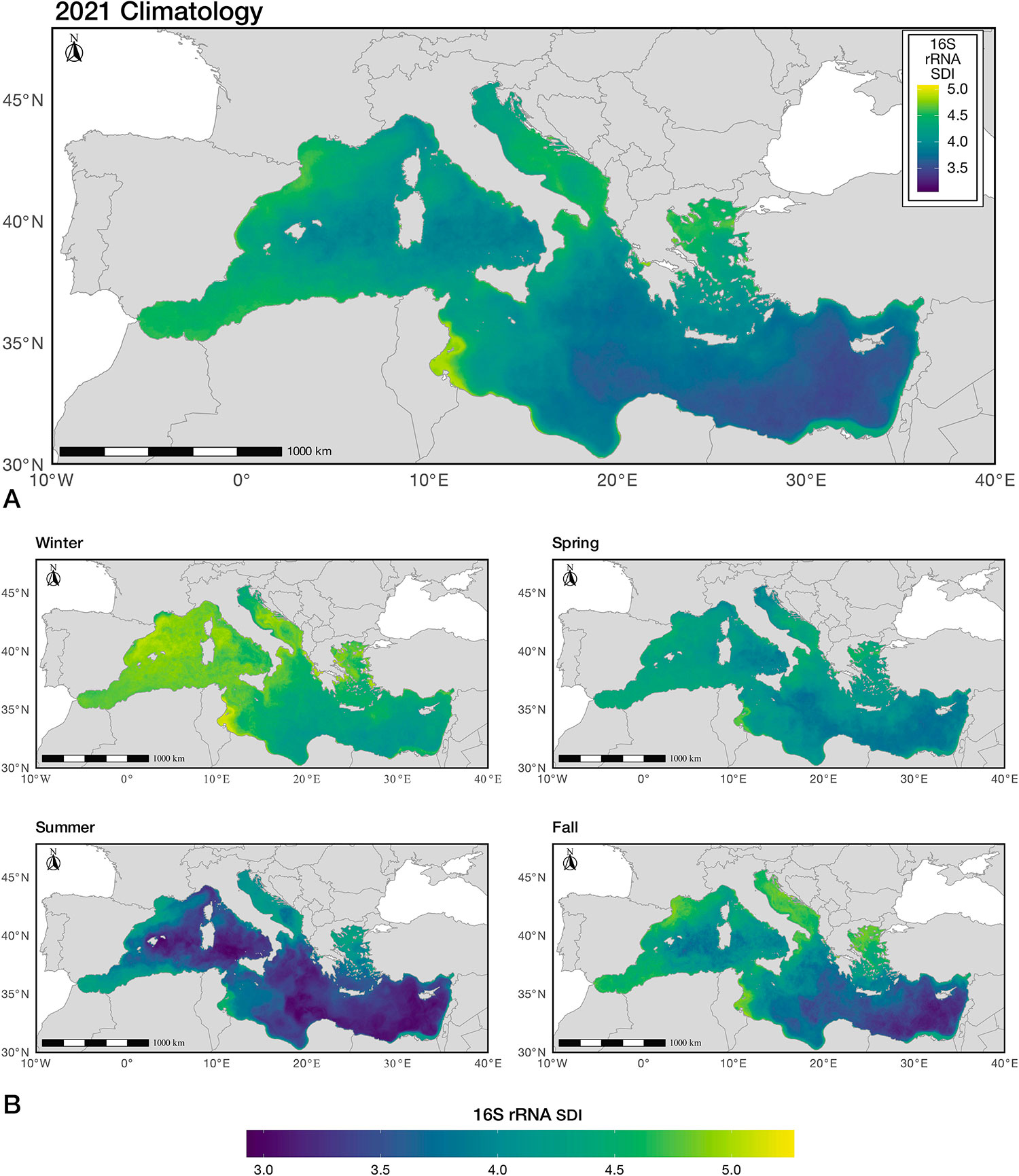
Expected results of PETRI-MED include the development and validation of several indicators related to marine ecosystem health and plankton biodiversity. These include an Alpha Diversity Index for plankton based on the Shannon Index combining information on phytoplankton groups derived from satellite ocean-colour observations. The project will also develop and Ecosystem Function indicator based on specific functional genes linked to processes such as domoic acid biosynthesis and phosphorus cycling. These indicators will rely on satellite optical radiometry and local algorithms.
► Predicted maps of prokaryotic community diversity based on the Shannon index 2021. Warmer colors (yellow) indicate higher predicted diversity, whereas cooler colors (blue to purple) indicate lower predicted diversity.
|  © Reproduced from Marchese et al., "Machine learning-driven mapping of prokaryotic community diversity in the Mediterranean Sea using omics, earth observation, and model data," Ecological Informatics, vol. 95, 2026, Article 103747, under the applicable CC BY license. |
🌍 The models are specifically tailored to the Mediterranean Sea. However, their overall methodology and architecture can be transferable to other regions, provided that sufficient in situ data are available for model training, verification and validation.
More information: https://petri-med.icm.csic.es
References
Marchese, C, Zoffoli, M.L., Ramond, P.-E., Logares, R., Bouget, Galand, P., Tinta, T., Orel, N., Volpe, G., Landolfi, A., Organelli, E., Machine learning-driven mapping of prokaryotic community diversity in the Mediterranean Sea using omics, earth observation, and model data, Ecological Informatics (95) 103747, 2026, https://doi.org/10.1016/j.ecoinf.2026.103747.
Related project(s)
- On Marine Biodiversity
- SCO BioEOS: Monitoring and characterizing the spatiotemporal dynamics of coastal biodiversity
- On the Mediterranean
- SCO AIonWetlands: Satellite monitoring and mapping of Mediterranean wetlands