TAHATAI Neo
A Digital Platform for Marine Spatial Planning
Overview
A heritage of global significance
Polynesian coastline is an exceptional natural heritage site, recognized worldwide for the richness of its lagoons, coral reefs and unique biodiversity. Within one of the largest exclusive economic zones (EEZs) on the planet, the scattered nature of the islands and the vastness of the maritime areas make their observation and monitoring particularly complex. Recognizing these challenges, the Government of French Polynesia has embarked on a Marine Spatial Planning initiative aimed at strengthening the governance and sustainable management of these areas. In this context, preserving this heritage in the face of the effects of climate change and growing human pressures requires innovative monitoring and decision-support tools, based on integrated and continuous knowledge of coastal dynamics. | Innovative technological solutions TAHATAI Neo is based on the QVX GeoAI platform and its VeeSat virtual monitoring stations, deployed in a cloud environment. The system aggregates multi-source, multi-scale satellite data*, supplemented by historical information. Centralized in a DataCube and accessible via the European DIAS infrastructure and interoperable APIs, these data streams power detection and tracking algorithms, dashboards, alert systems, and web and mobile applications. |
The TAHATAI Neo Solution
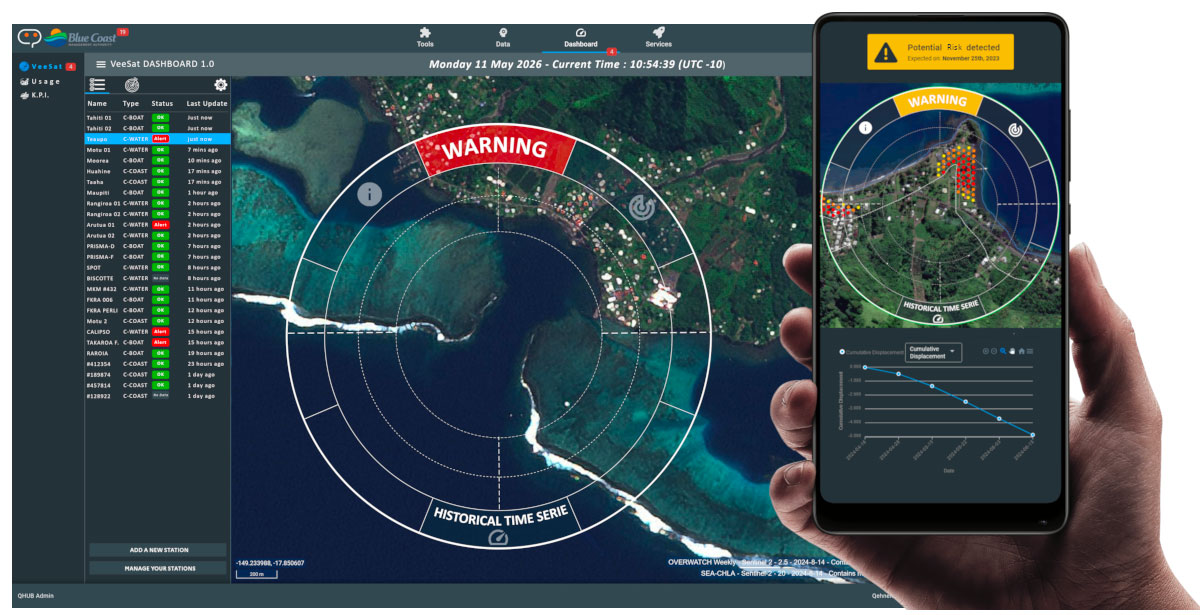
Through the deployment of new space-based applications and monitoring indicators, the project provides an integrated and forward-looking view of coastal dynamics. It centers on three challenges:
Anticipating changes in water quality in the context of climate change.
Gaining a better understanding of the uses and visitor numbers in the lagoon and along the coast.
And assessing the human pressures exerted on these environments in order to support the sustainable and resilient management of coastal areas.
► VeeSat system integrated into the QVX and VeeSat Mobile platforms. © Tauhã et Quintesens
A multidisciplinary and multi-sectoral approach
Effective coastal management also relies on the ability of stakeholders to develop a shared vision and to share the knowledge required for decision-making. This governance challenge lies at the heart of TAHATAI Neo and the technology deployed.
TAHATAI Neo provides user communities in French Polynesia with collaborative workspaces and working methods that have been developed, tried and tested over many years. These enable the various coastal stakeholders to generate, share and capitalize on the knowledge essential for risk anticipation and coordinated territorial management.
This approach brings together a wide range of stakeholders – decision-makers, institutional technical departments, industry, associations, NGOs and scientists – around a single objective: to strengthen coastal governance through improved information flow and decision-making informed by scientific data.
► Integration of local knowledge and satellite data into the QVX platform for French Polynesia. © Quintesens | 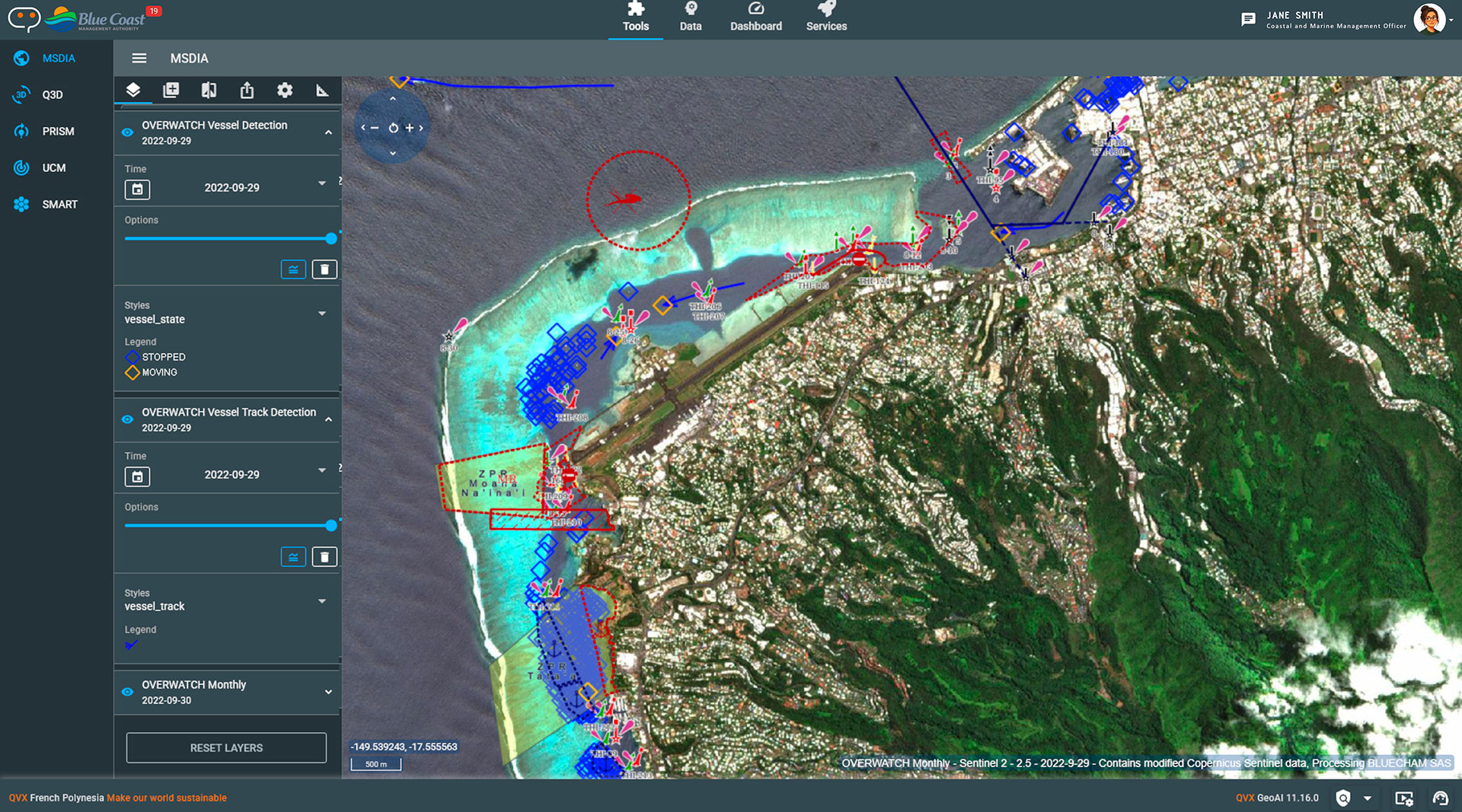 |
Project Consortium
The project is led by the innovative start-up Tauhã, a member of FrenchTec NC and specializing in virtual coastal monitoring stations. Its Director, Rémi Andreoli, a physical geographer, is a senior figure in the Earth Observation (EO) industry.
The partnership is built around a highly motivated team from French Polynesia, France, New Caledonia and Australia.
👥 See all consortium members here.
Application site(s)
Following on from the initial TAHATAI project, TAHATAI Neo is being rolled out primarily in French Polynesia.
A vast scope for future action
To take things even further, TAHATAI Neo aims to extend its scope across the Pacific, in order to contribute to a regional dynamic of knowledge-sharing and preparing for future changes. Initial discussions are already underway with several partner territories, notably Vanuatu, Fiji, Papua New Guinea and Australia, which is particularly concerned about the Great Barrier Reef. ► Vanuatu’s QVX GeoAI platform during Cyclone Lola in October 2023. © Quintesens | 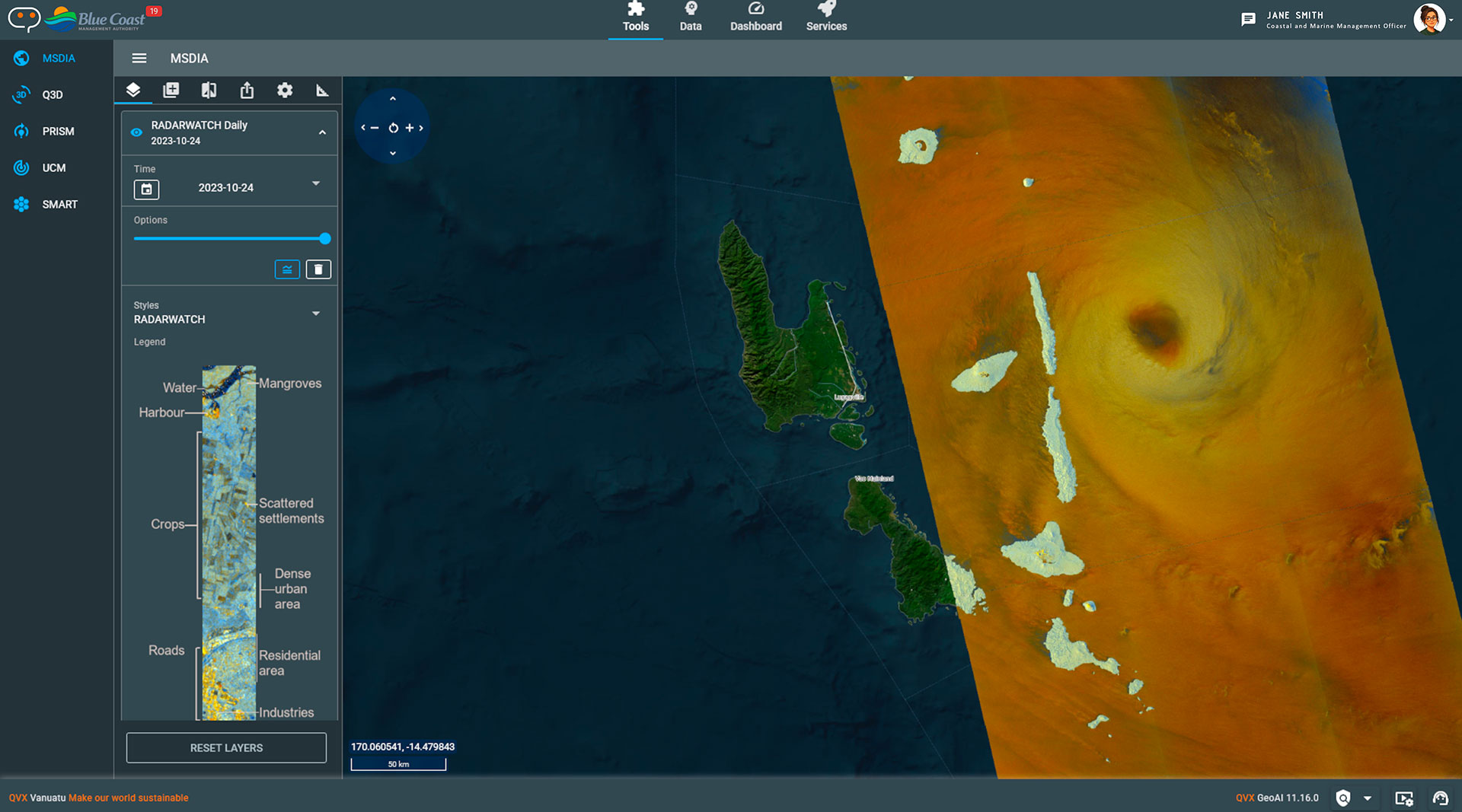 |
Beyond the specific characteristics of each territory, the nations of the Pacific face common challenges: the vulnerability of coastal areas, growing pressure on resources and the impacts of climate change. By promoting the sharing of data, expertise and experience, TAHATAI Neo hopes to contribute to better coastal protection at a regional level
Data
Satellite
Multi-source, multi-scale satellite data from:
the Copernicus Sentinel-1, Sentinel-2, Sentinel-3 and Sentinel-5 constellations
public programmes such as Landsat
as well as very high-resolution and commercial imagery, notably from Pleiades, BlackSky, Maxar and French NewSpace operators.
Other
Historical and sector-specific information from the Government of French Polynesia.
Results – FInal product(s)
TAHATAI Neo focuses, beyond access to data and computing resources, on:
- The deployment of desktop and mobile applications fed by satellite feeds and the added value (indicators) resulting from their processing;
- The realization of the scaling up of the two pilot sites of TAHATAI (Arutua and Tahiti) to the whole of French Polynesia 👉 see the results of TAHATAI
- Automation and security of new real-time processes;
- The deployment of the economic model in French Polynesia to all the actors of the blue sector, then internationally (Vanuatu, Fiji, India);
- The massive opening to the user community of the tools, algorithms and applications developed within the framework of the TAHATAI Neo project via the QVX digital platform;
- The definition of new, complex and innovative processes in conjunction with the actors in the field.
TAHATAI Neo, through the QVX digital platform of French Polynesia, will be the showcase of applications for Marine Spatial Planning focused on the preservation of the blue resource (water quality, human pressures) and the use of lagoon and coastal waters. With a community of users at different levels and use cases, the solution will be extended to other territories according to an adapted economic model, integrated in the QVX Market Place.
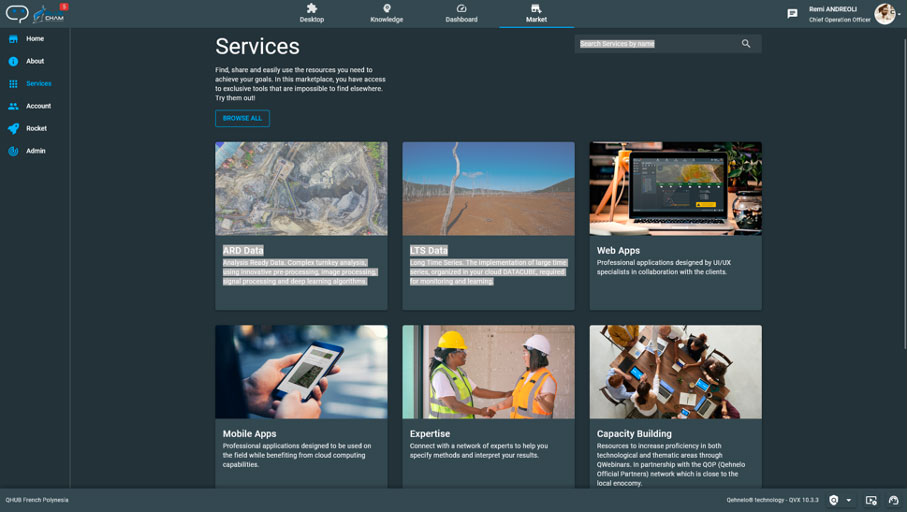
Market place in the Digital QVX Platform. © BLUECHAM
Related projects lis
SCO Projects
TAHATAI, the original project of which TAHATAI Neo is the scaled-up version
SCOast-DT: development of coastal digital twins
Non-SCO projects
RESPECT: Remote Sensing of Pressure Erosion on Coastal Ecosystems in New Caledonia
VeeSat – Protect what is essential: Virtual sentinel stations that continuously monitor the most sensitive sites and transform satellite data into directly actionable alerts.
QVX GeoAI – Make our world sustainable: a geospatial intelligence platform that transforms Earth observation into operational indicators to anticipate changes and inform sustainable decision-making.
Project news
- 11/06/2025 : QVX-PF, power made TAHATAI Neo
- 🎥 27/03/2025 : Presentation of the TAHATAI Neo project and its progress at the 16th SCO France Quarterly Meeting « Coastal ranges: challenges and solutions »
- 30/04/2024 : TAHATAI Neo takes shape, project launch