Target 2050
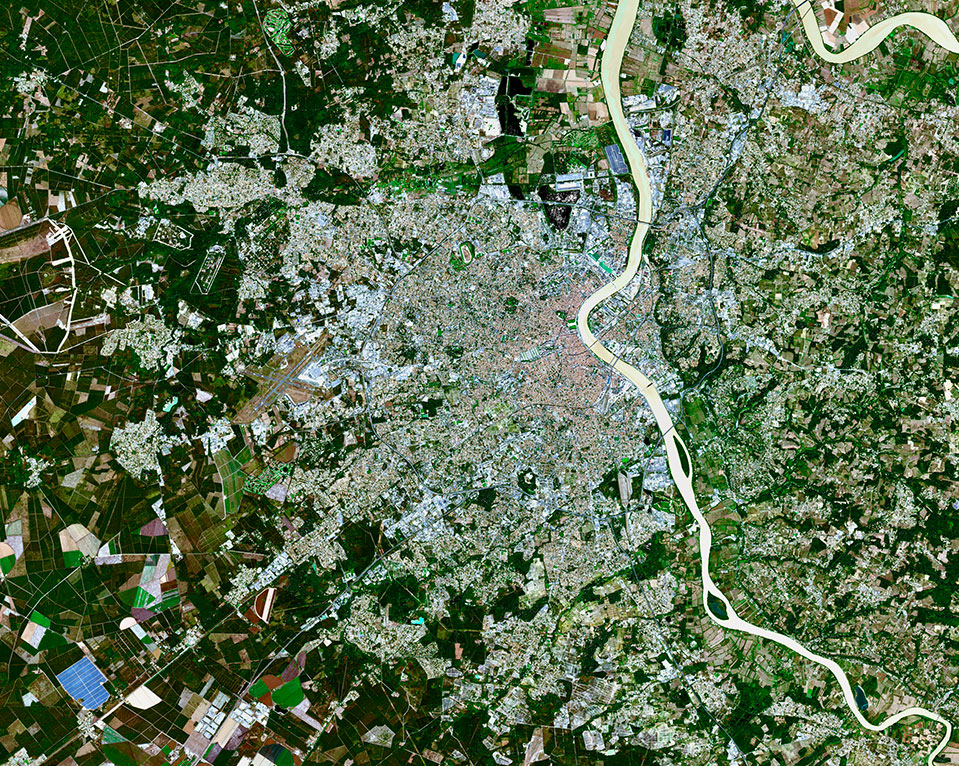
Reinforcing urban resilience through renaturation
Project completedThe SCO Target 2050 project has resulted in an online application that enables local authorities and developers to assess and optimize the climate performance of their development projects in line with France's 2050 targets for carbon neutrality, zero land artificialization, and adaptation to +4°C. The solution is marketed by NetCarbon.
Overview
Already home to 55% of the world's population and soon to more, urban areas have a dual role to play in the face of climate change: adaptation and mitigation.
The renaturation initiatives undertaken by local authorities provide a pragmatic response to these two challenges. In fact, nature in the city helps to reduce the concentration of CO2 in the atmosphere thanks to the carbon stored by plants, and also makes our cities more resilient in the face of extreme weather by protecting us from heatwaves and reducing the risk of flooding and soil erosion.
In fact, the subject of renaturation is omnipresent in local authority decision-making at all levels. The place left to nature is studied in every development project and renaturation roadmaps are put in place.
However, local authorities face two problems:
The first is that you can only improve what you can measure. However, it is very difficult to measure the impact of a renaturation/development policy with regard to the objectives of combating climate change by 2050.
The second is technical: what should be planted where? This issue is particularly relevant in urban areas, where there are obvious technical constraints, and where the effects of climate change need to be taken into account when choosing plant species.
It is only by responding to these two challenges that ambitious renaturation policies can be deployed on a large scale and make a significant contribution to the fight against climate change, with a major environmental and social impact.
Today, the Netcarbon platform can already be used to take stock of an area and its development since 2018 in terms of a range of indicators (carbon sequestration, heat islands and artificialization), as well as simulating the impact of development projects. However, there is no solution to go further and enable local authorities to take stock of the impact of their actions. Development plans are drawn up without measuring their degree of alignment with the strategy to combat climate change.
The Target 2050 solution
In collaboration with Bordeaux Metropole, Netcarbon developed its platform so that it can simulate the impact of a development project and propose optimized development scenarios to be proposed with regard to the three major challenges of the strategy to combat climate change by 2050:
- Carbon neutrality (Paris agreements)
- Zero Net Artificialization
- Adapting to a +4°C trajectory in France
To achieve this, the solution takes into account:
- The outlook for climate change as defined by the IPCC
- Plant species and their ability to adapt to climate change
- Technical constraints
- Implementation costs
The SCO Target 2050 solution has relied on Netcarbon data to assess the current situation, composed of the UHI (Urban Heat Island) indicator developed by the SCO Sat4BDNB project, and supplemented by Landsat8 data, vegetation cover data and carbon capture data based on Sentinel2 and BD Ortho data outputs. These data are available in the Netcarbon application and may be updated in line with the latest technologies available, such as TRISHNA data.
Users
The SCO Target 2050 solution can be used across the board in local authorities (metropolises and communities of communes > 50,000 inhabitants) by meeting the needs of 3 types of players:
- Economic Development Department: estimate the impact of each development project on the environment and analyze its suitability in terms of strategies to combat climate change.
- Environment/Nature Department: to facilitate the definition and implementation of renaturation strategies by providing a tool for knowing what to plant, where to plant it and for what effect.
- Elected representatives: make it possible to report on the impact of renaturation policies, both internally for the purposes of improving the choices made by local authorities, and for citizens in search of transparency. This should be done not through a balance sheet (number of trees planted) but through the impact of actions on climate change (quantity of carbon stored, reduction in heat islands, de-waterproofing, etc.).
Application site(s)
France :
- Bordeaux Metropole
- Croissy sur Seine
Data
Satellite
- Sentinel-2
- Landsat 8 & 9
Other
- Albedo: automated measurements as part of the SCO Sat4BDNB project
- CMIP6: Copernicus Climate Change Service
- BD Ortho: IGN
- PANGEO architecture
- Microsoft Planetary Computer
Results – Final product(s)
Marketed by Netcarbon, the Netcarbon Intelligence application is now operational for simulating the impact of a development project and proposing optimized scenarios in line with national objectives. Co-construction with partner local authorities guarantees a smooth experience and immediately usable results.
| 👉 To make it easy to analyze whether a development project is in line with the 2050 trajectory and to enable projects to be compared with each other, Target 2050 has developed a unique project impact rating system. This considers the impact on carbon storage, artificialization, rising temperatures, and the complexity and cost of implementation. | To obtain an A rating, a project must:
|
👉 The process is fully automated based on the site plans provided by the project developers:
- Initial assessment: automatic calculation of the three criteria (carbon, ZAN, temperature) and assignment of a rating from A to E.
- Development simulation: the user enters the planned actions (planting, change of materials, de-impermeabilization, etc.).
- Time projection: effects simulated every 5 years up to 25 years (temperature gain, carbon storage, preserved soils).
- Optimization: testing of variants (species, colors, materials, permeability, etc.) until the most effective combination is found.
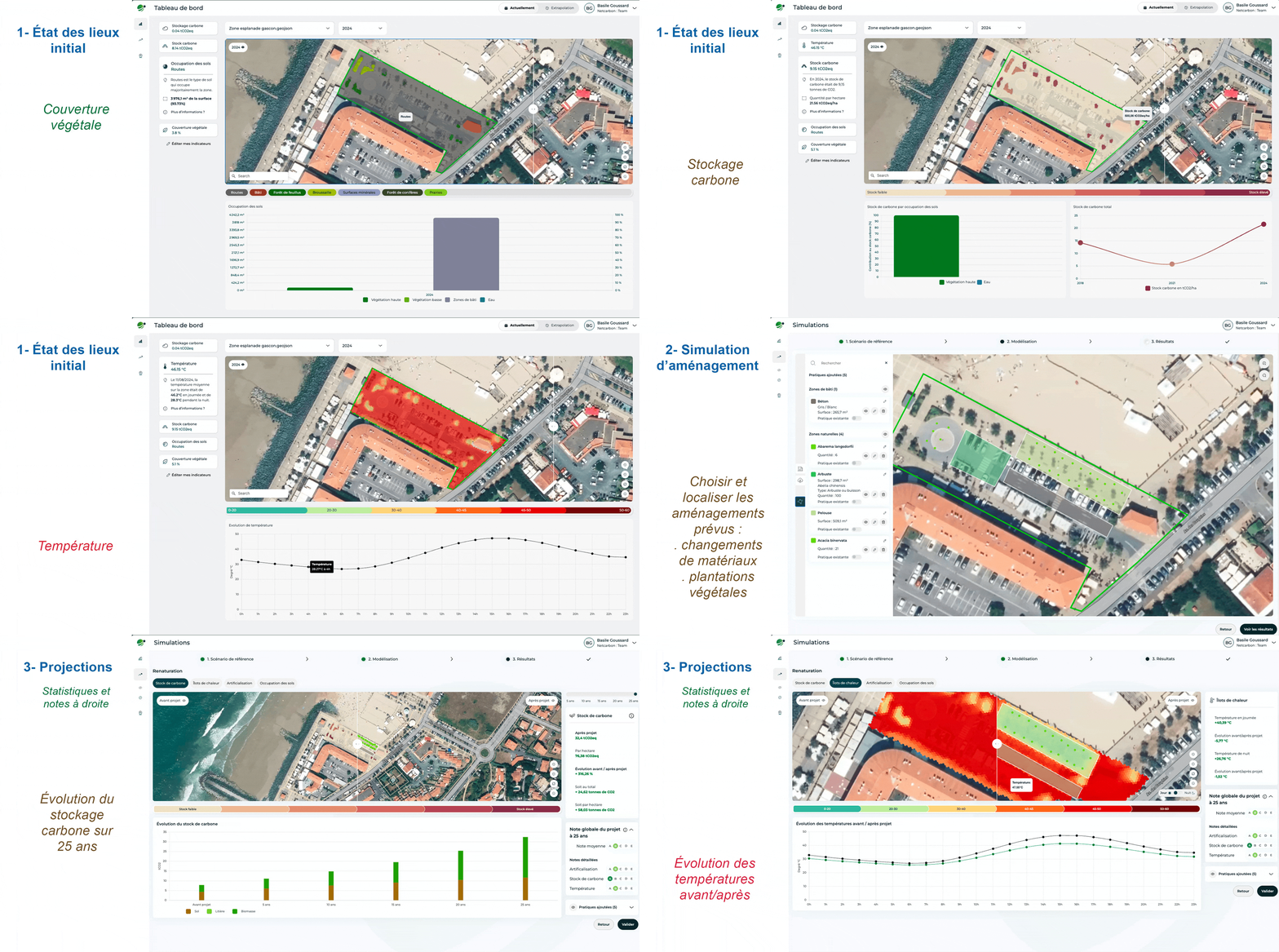
Main steps of the Netcarbon Intelligence application. © Netcarbon
Outlook
Following the success of Target 2050, the Netcarbon teams are working on two major areas of development:
- Automated scenario optimization: enrichment of species and material libraries, and automatic generation of “climate-positive” scenarios.
- Taking perceived temperature into account: going beyond surface temperature to better estimate users' thermal comfort.
Related project(s)
- SCO Sat4BDNB, satellite data for the French National Buildings Database
- SCO GreenSpace, urban tree mapping and planting recommendations
- SCO Green Urban Sat, an observatory of urban vegetation
Project news
- 09/09/2026: Presentation of Target 2050 at the International Space Summit
- 09/12/2025 : Target 2050: building tomorrow's world today
- 📺 09/10/2025, interview with Basile Goussart on B SMART TV (in French)
- 🎥 22/09/2025: Presentation of the Target 2050 project and its progress at the 18th SCO France Quarterly Meeting