


SCOFrance
10Accredited projects in 2026
Urban adaptation
Atmosphere and GHGs
Biodiversity
Water management
Land use
Natural disasters response
Previous editions2025, 2024, 2023, 2022, 2021, 2020
Next call for projectsSeptember 1, 2026


SCO France: 2026 Edition
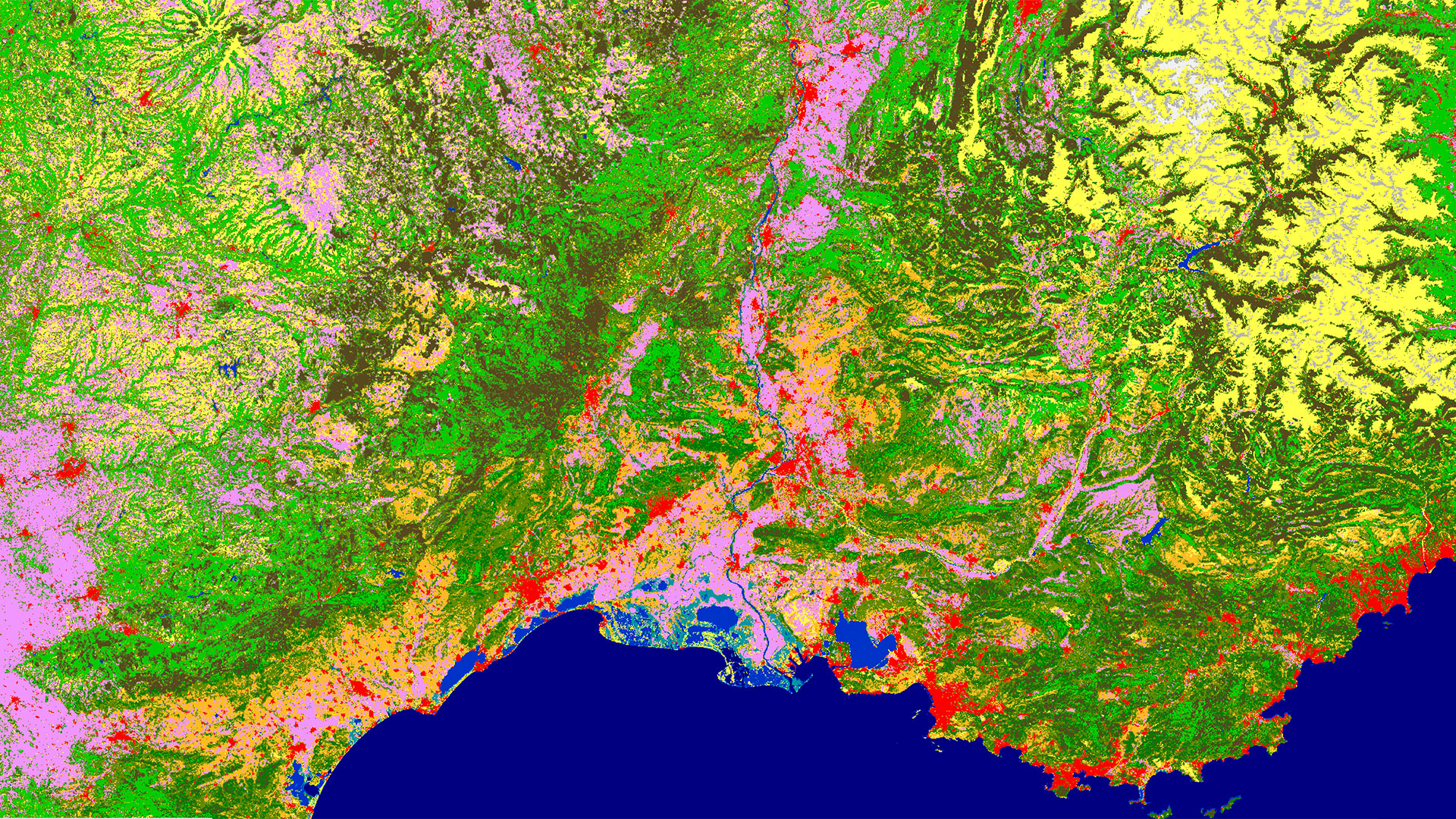
Innovative spatial responses to issues related to climate change, the winners below answered to the call for projects conducted from 1 September to 17 November 2025. We would like to thank the 26 reviewers from SCO France who worked tirelessly to examine the numerous applications submitted and whose combined expertise enabled us to select the most promising solutions.
| Among them is Johan Ransquin, Director of Adaptation, Planning and Trajectory at ADEME (French Environment and Energy Management Agency), who has been a reviewer since the first call for projects. At the same time last year, during the 3rd SCO France Congress, he gave us the keys to adaptation, which are directly in line with the SCO's mission. |
Urban adaptation: 3 projects
Led by ACRI-ST and UMR ESPACE
DTwin4City is developing an urban digital twin to support the greening strategies of cities facing urban heat islands and air pollution. By combining satellite data, artificial intelligence and climate scenarios, the tool will identify priority areas for revegetation, quantify the benefits of green spaces and guide long-term planning. Tested in Le Mans and Nice (France), it will facilitate understanding of the interactions between vegetation, traffic and air quality.
- HOSWA: Ho Chi Minh City Observatory for Adaptation to Subsidence and Water
Led by TOMOSAR, INRAE and IRD
Ho Chi Minh City is one of the 10 cities most vulnerable to climate change. The main problem is critical subsidence, with parts of the city sinking due to groundwater extraction. Based on Sentinel-1 and SWOT data, this first observatory will provide a high-resolution tool for simultaneously monitoring, in 2D, land subsidence and surface water elevation. HOSWA will thus provide an operational WebGIS platform to guide climate adaptation and protect critical infrastructure. The solution will be transferable to other coastal megacities.
- SCOPE - Simulation of Comfort and Overheating in Public Environments
Led by NetCARBON and the RUPEE Lab
Following on from the SCO Target 2050 project, SCOPE is developing a methodology to assess the perceived temperature in urban environments at pedestrian level. The tool will cross-reference satellite, climate and contextual data to measure outdoor comfort and quantify the impact of urban developments. Available via an open platform, the results will support the thermal resilience strategies of major French cities, with a view to climate adaptation and sustainable urban planning.
Atmosphere and GHGs: 1 project
- FLAREWATCH
Led by KAYRROS, the Borelli Centre (ENS Paris Saclay) and Carbon Limits
FLAREWATCH is developing a real-time satellite detection platform for gas flaring and associated emissions, one of the most avoidable sources of greenhouse gases. In order to enhance transparency and international monitoring of emissions linked to oil and gas production, the project will estimate the power and temperature of flares using an innovative multi-sensor approach (MTG-I, GOES-R and Himawari satellites). The operation will be carried out with the World Bank, an expert organization and potential end customer, whose international footprint will enable the transition to scale to be validated.
Biodiversity: 1 project
- SAGA – System for anticipating and managing green algae strandings
Led by ACRI-ST and ACRI-IN
SAGA is setting up an operational system for anticipating green algae strandings on the Channel-Atlantic coast, a phenomenon whose origin and dynamics remain poorly understood despite numerous in situ measurement networks. By combining satellite data (Sentinel-2 and 3, Pleiades), hydrological modelling and artificial intelligence, the project will produce maps of changes and environmental indicators. The tool will thus support coastal management and the shellfish industry in dealing with these phenomena, which have a significant ecological and economic impact.
Water management: 1 project
- WWQP – Water World Quality Portal
Led by UNESCO and CNES
WWQP is deploying an operational system to monitor water quality and hydrology in Lake Turkana in Kenya, the world's largest desert lake, where the lack of reliable long-term data is hampering the development of adaptation strategies. By integrating Sentinel-2 data, in situ measurements and hydrological indicators, the WWQP portal will produce freely accessible, high-resolution indicators on transparency, turbidity, sediment input and eutrophication. The project thus aims to strengthen the resilience of ecosystems and riparian populations to support climate adaptation and local policies for water and food security.
Land use: 2 projects
- DESAF – Desertification: automated assessment and monitoring in France
Led by Nitidæ, CSFD and Data Terra
DESAF is setting up the first national observatory for monitoring desertification and aridity in France, both in mainland France and in the overseas departments and regions (DROM-COM). Hosted and maintained by the THEIA data center of the Data Terra research infrastructure, the platform will calculate and update multi-scale indicators based on satellite (MODIS, Sentinel-2, JRC) and meteorological data. Providing public actors with visualization, analysis and export tools to inform management policies for sensitive areas, the tool will feed into the future National Action Plan and serve as a replicable model for Southern Europe.
- GEOPARK - Geolocated Estimation and Observation of PARKing areas
Led by CEREMA and Murmuration
Using Pleiades satellite images, GEOPARK detects car parks and then characterizes them according to their potential for greening, photovoltaic production and their contribution to urban heat islands. An interactive mapping interface will enable local authorities to enrich and exploit locally produced data. Tested in Lille and Greater Poitiers (France), the project will provide a replicable and operational tool to improve the management of artificial spaces and guide actions to reduce impermeability, increase vegetation and promote energy recovery.
Natural disasters response: 2 projects
- RIVERS – Rich Immersive Virtual Environments for Education using Remote Sensing
Led by IRD and INRAE
RIVERS aims to design a platform to raise awareness of flood risk management that integrates remote sensing data, hydrological modelling and immersive virtual reality technologies. By combining this data with social dynamics, the platform will simulate flood trajectories, evacuation scenarios and flood mitigation strategies. The platform will be implemented in Southeast Asia and France.
- CLAYEXP – Clay Exposure
Led by Deltaforms and CNRS/Data Terra
Widespread globally and directly linked to soil moisture, clay shrinkage/swelling (CSS) is a dynamic process that is strongly modulated by weather conditions. With a demonstrator in the Occitanie region, CLAYEXP is developing two indices of exposure to the risk of CSS based on Earth observation data. By combining Sentinel data, meteorological information and InSAR radar techniques enhanced by artificial intelligence, the aim is to detect ground deformations and anticipate impacts on buildings and infrastructure.